
Other news: Amputees Start Favoring Metal Prostheses To Realistic Artificial Limbs
Hartford Courant/William Weir
May 30, 2008
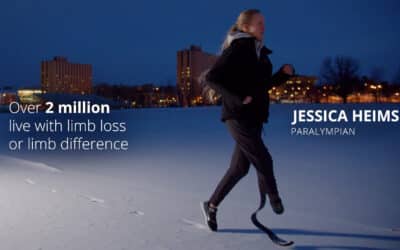
South Africa's Oscar Pistorius is trying to make his country's Olympic team, over the objections of some in the track world who say his metal legs give him an unfair advatage. (ANDREW MEDICHINI / AP / July 13, 2007) However you feel about South African runner Oscar Pistorius' fight for a place on his country's Olympics team despite two below-the-knee amputations, it's hard not to be amazed watching him run. Particularly striking is the look of his artificial limbs — running blades made of carbon fiber where his feet once were. It's a futuristic look (his nickname, "Blade Runner," is particularly apt), and for some amputees — mostly younger guys — that's a definite plus. It used to be that a top-notch prosthesis looked like an actual limb. But as artificial limbs become more common and technologically better, a new generation of prosthetics users are embracing a gleaming, mechanical aesthetic. At a time when thought-controlled prosthetic limbs are becoming reality, it would be easy to dismiss the aesthetic choices behind artificial limbs as simply a question of style. But rather than try to pass as able-bodied — as once was the norm for prosthesis users — choosing to present their disabilities to the world reflects a significant change in attitudes. "It's a question of choice, and more and more people — especially young people — find it very cool to look like the Bionic Man," says Salisbury resident Paddy Rossbach, president and CEO of the Amputee Coalition of America. "People are finding themselves to be more active and feel good about themselves. Therefore, they are not trying to h At BioMetrics, a Trumbull provider of prostheses, President Robert Dzurendura says he has seen an increase in unadorned artificial limbs. "Generally, our younger population, from 30s on down to lower 20s, a lot of those patients don't want it covered; they generally want it exposed," he says. "We've had people who think it looks neat and walk around with shorts and are basically trying to show it off. People say 'You know what — people know I lost a leg, so why try to hide it?'" Pistorius' blades — Cheetah Flex-Foots, made by the Icelandic company Ossur — are made specifically for running. There's no heel, so walking and standing are awkward. Some wonder if they're too functional; fellow Olympic hopefuls say Pistorius' prosthetic feet actually give him an advantage over able-bodied runners. Few amputees will be in Pistorius' position. But even when it comes to everyday use, many prosthetics users are embracing the Robocop look. "They look at their prosthesis as a badge of honor by not covering it," says Meghan Eilbeck, marketing manager for Freedom Innovations, a maker of prosthetic limbs. "It's a show of what they've overcome, whether it's in athletics or not." She figures the popularity of the "high-techie" limbs began in the last 5 to 10 years. Nonetheless, she says, most still want some kind of cosmetic covering for their prosthetics. For them, there are cosmeses — prostheses designed to look like human limbs. Just as prosthetics technology continues to improve functionality, science has created limbs that can pass as flesh and bone even on close scrutiny. Dzurenda says that for clients wanting a particularly detailed limb, work can involve duplicating the client's skin right down to the veins, hair and sunspots. It costs a few thousand dollars more and, like Pistorius' running blades, few insurance companies will cover costly cosmetic touches. Insurance is a touchy subject. Companies' price caps and refusal to pay for maintenance of artificial limbs have prompted protests among prosthetics users in Connecticut and across the U.S. Some believe the war in Iraq might pressure insurance companies to provide better prosthetics coverage. At last count, about 780 soldiers have lost limbs in Iraq and Afghanistan. They account for only a small fraction of the 185,000 new amputees in the U.S. each year, but they're high-profile cases. If a 20-year-old soldier is outfitted with a state-of-the-art prosthetic, Dzurenda says, it's hard for insurance companies to argue that a 20-year-old civilian couldn't also benefit from similar technology. There are approximately 1.8 million Americans living without a limb. There are no figures for how many are using artificial limbs. Diabetes-related complications are the most common cause for amputations. And as the incidence of diabetes increases, due to the prevalence of obesity, so do the number of amputations. At BioMetrics, much of the customization takes place in the workshop of prosthetics technician Peter Posci. With tools hanging on the wall and a ZZ Top cassette playing on the boombox, it's pretty much like any other workshop, except that all the vises are holding artificial limbs. One of them is a C-leg, also known as a microprocessor knee. It's a limb for above-the-knee amputees, and one of the most advanced prosthetics on the market. Computerized so that the knee and foot communicate with each other to ensure a more natural stride, it costs about $45,000. (Most of the company's clients don't have insurance that could cover anything like that.) Function comes first, of course, but appearance counts for something. Posci, a former carpenter who came to the U.S. from Hungary in 1983, says its important to find out exactly what each client wants. Sometimes they have rather singular requests. The company recently completed a prosthetic leg for one client who wanted tattoos of the Red Sox logo on his new limb. Posci delivered; the client even got it signed by some Red Sox players. Contact William Weir at bweir@courant.com.
|